
It's the 20th. You're at 48 points, and Gold takes 60. The app shows a progress bar, and it's hard not to want to fill it.
Before you start taking every offer that pops up, ask a better question than "can I make Gold?" Ask: "What is Gold worth to me, and what will it cost to get there?"
Here's how to answer it.
What it takes
Your tier is set by 2 things together: the points you earn this month and your My Metrics. You need both.
| Each month | Silver | Gold | Sapphire |
|---|---|---|---|
| Points | 20 | 60 | 120 |
| On-time arrival at pickup | 93% | 95% | 96% |
| Completion rate | 93% | 95% | 96% |
| Quantity found | 96% | 98% | 99% |
| Customer rating | 4.6 | 4.8 | 4.9 |
Points come from completed trips, and the points for each trip show on the offer card before you accept. They vary from trip to trip. Points reset on the 1st of every month.
Tiers are available in select zones, and Walmart says rewards can change. Check My Metrics and Rewards in your app for yours.
What each step up gets you
| Reward | Silver | Gold | Sapphire |
|---|---|---|---|
| Cellular discounts | |||
| Tax filing help | |||
| Dashcam app offer | |||
| A month of Walmart+ | |||
| See some offers before Silver and no-tier drivers | |||
| See some offers before Gold drivers too | |||
| +10% on eligible incentives |
Step 1: Put a dollar value on each perk
A perk is only worth what it saves you or earns you. Go down the list and be honest.
- Discounts and partner perks. If you'd use them anyway, count what they save you. If you wouldn't, count $0. A discount on something you don't buy isn't a reward.
- A month of Walmart+. Worth what a month costs, but only if you'd have paid for it or would use it.
- The +10% multiplier (Sapphire). It applies only to eligible incentives, not to every trip. Look at what you earned from incentives last month. If eligible incentives paid you $50, 10% is $5. If your zone runs few incentives, it's worth little.
- Seeing some offers first (Gold and Sapphire). This is the one drivers talk about most, and the hardest to price. Walmart's own help page says your tier is only one of several factors in which offers you get, and it doesn't guarantee any offer or number of offers. Treat it as a possible bonus, not a number you can count on.
Add up the perks you'd use. That's what the next tier is worth to you.
Step 2: Work out what it costs
Now the other side. How many more points do you need, and what kind of trips will get you there?
Say you're at 48 points and need 60. That's 12 more points. Look at the points on the offer cards you've been getting.
- If you'd reach 60 with offers you'd take anyway, the tier is free. Take it.
If you'd have to take offers below your usual floor, count what those cost you. Say you'd need 4 offers you'd normally decline, and each one runs 12 miles round trip for $10:
Miles: 4 × 12 = 48 miles
Cost at the IRS rate of 76¢: 48 × 76¢ = $36.48
Pay: 4 × $10 = $40
You'd clear $3.52 for 4 trips' worth of time. If the Gold perks you'd use are worth more than that time to you, go for it. If not, let it go.
Example numbers to show the math. Points per trip vary, and your car may cost more or less than 76¢ a mile.
Every tier decision comes down to offer math. The free Earnings Maximizer puts it on one page. Get the free guide →
Step 3: Watch your metrics, not only your points
Points are only half of it. A month full of points won't unlock Gold if your on-time arrival slips under 95% or your customer rating dips under 4.8.
Chasing points can push those the wrong way. Rushing into offers you'd normally skip, at stores you don't know, is how on-time arrival slips. Accepting offers and then dropping them hurts your completion rate. So if you go for a tier, go for it with offers you can deliver well.
Step 4: Decide, and don't look back
Put the 2 numbers side by side:
- What the next tier is worth to you, from Step 1
- What it costs to get there, from Step 2
If the first is bigger, go for it. If the second is bigger, stay where you are and enjoy the freedom to decline. Either way, it's your call, made with numbers instead of a progress bar.
The bottom line
The next tier can be worth it. It can also cost more than it gives back. The only way to know is to do the math, and it takes about 5 minutes.
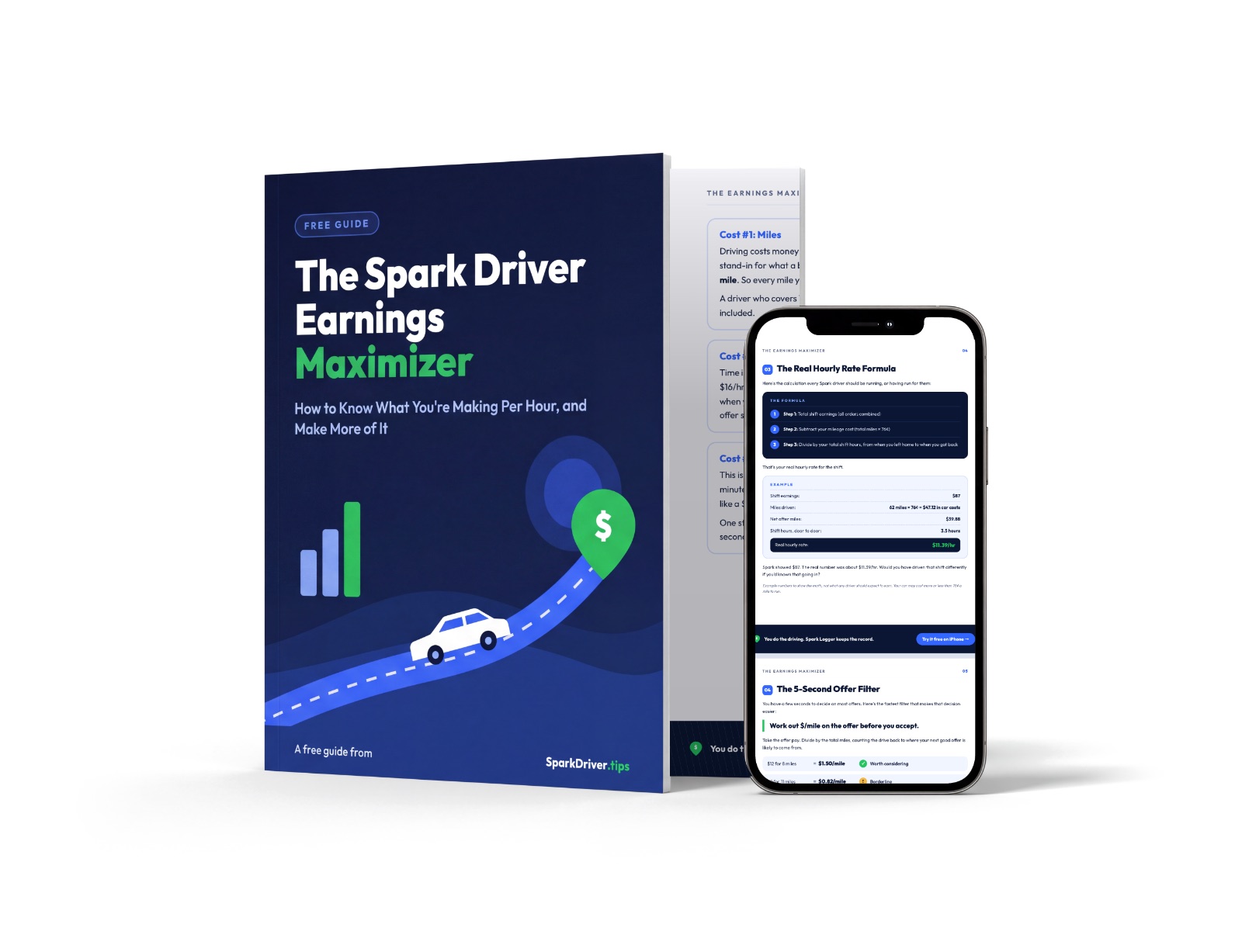
Know what you make per hour, after miles
- The real hourly rate formula
- A 5-second offer filter
- The worst-stop rule for batches
Sources: Spark Driver Rewards Program (help center) · Spark Driver Rewards page · IRS standard mileage rates